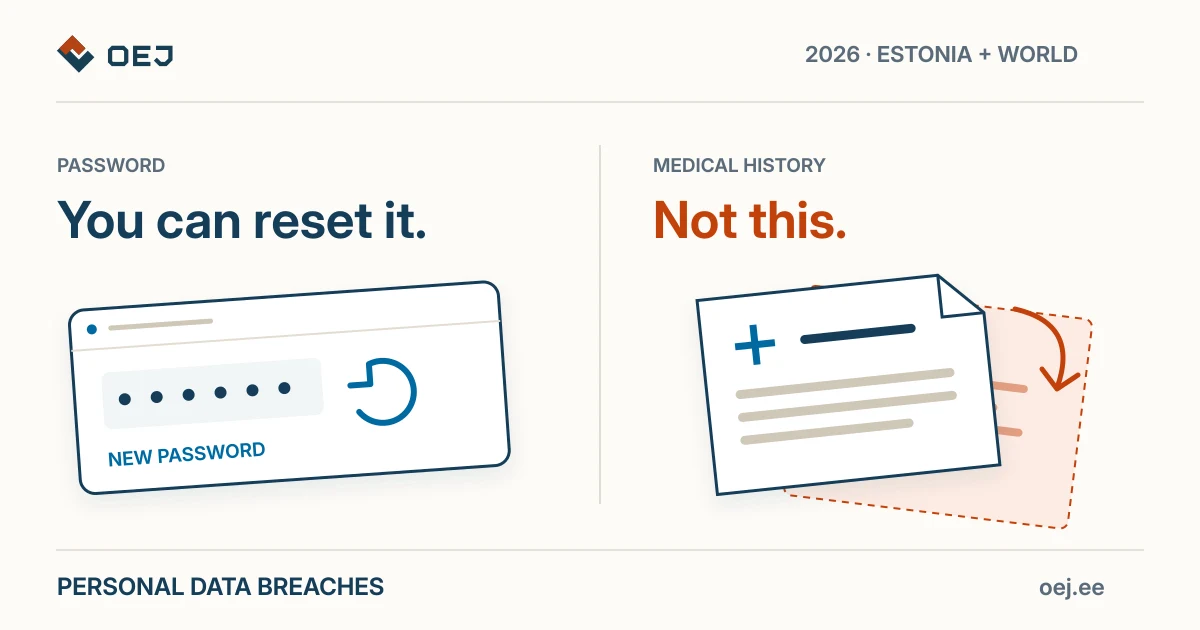
You can change your password. Not your medical history.
2026 data breaches in Estonia and worldwide: much more than passwords.
Distinguish access, copying and publication, and ask the provider whether an incident affects you.
Changing a password cannot undo treatment you received or retrieve correspondence someone has copied. You can replace an account’s lock, but not rewrite a person’s past.
Correct personal details can make a fraudulent message convincing. Knowing those details does not make its sender trustworthy. 12
Ten cases show why headline qualifications matter. Was information accessed, copied or published? Does the number count people or records? Does “leak” mean publicly available?
Facts checked through 30 October 2026; research completed overnight on 27 October, Tallinn time. The Park24, Odido and Instructure rolling notices were re-checked on 30 October. These incidents occurred, were discovered or were disclosed this year. This is not a full-year total or exhaustive global list. Dates are labelled. Sources are authorities and the organisations involved.
Estonia: from bookings to treatment records
An incident naming an institution may concern just one service, not all its systems.
Southern Estonian business: reported in the June overview
Estonia’s Information System Authority, RIA, describes a booking-system leak involving names, document numbers, birth dates, citizenship, addresses, contacts and booking details. Attackers compromised an employee account protected by a weak password without multi-factor authentication. The business, affected count and precise attack date are not identified. June is the reporting month. 1
Innovaatik and Hammas: September disclosure, October clarification
RIA described repeated unauthorised access and downloading, provisionally involving data held by over 300 healthcare providers. That is not a patient count. A suspect was detained; no misuse or onward sharing was known. 2
Medisfäär’s 16 October update confirms queries of dental treatment entries, internal notes, and invoice and payment lists, excluding other specialties. Citing police and prosecutors, it reports seized downloads and no evidence others obtained them, not proof every copy was destroyed. Attack dates are unspecified. 4 The regulator acknowledged the incident on 4 September. 3
University of Tartu online bookshop: detected 11 September
RIA says customers’ names, contacts, usernames, encrypted password representations, purchase histories and IP addresses were very likely downloaded from the online bookshop. An unpatched vulnerability was the preliminary explanation. This concerns the shop, not the whole university or every student; downloading is described as highly likely, not conclusively established. 2
“Is my information safe?” may have no simple answer. One category is understood; another remains under investigation. That excuses neither a provider’s silence nor a news report inventing certainty.
Around the world: seven cases on a timeline
Entries follow known attack dates, otherwise discovery or disclosure. A notice’s publication date must not become an invented intrusion date.
Navia, United States: access spanning the new year
Washington’s Health Care Authority reports access between 22 December 2025 and 15 January 2026, discovered in late January. Nationwide scope: 2.7 million records, not necessarily that many people. Information included identifiers, birth dates, addresses and contacts, with Social Security numbers in some programmes. There was no evidence that bank-account or claims data were accessed. 5
Odido, Netherlands: attacks on 5 and 6 February
Odido’s latest FAQ puts the affected population at about 6.39 million people. The attacker impersonated IT support. Categories varied by person and could include contact details, IBANs and identity information. The company excludes Mijn Odido passwords, call and location data, invoice information and identity-document scans. Not everyone lost every listed field. 6
TENGA: 13 February mailbox notice
A notice hosted by California’s Attorney General says unauthorised employee-mailbox access was discovered on 13 February. The account was also used to send spam. Names, email addresses and historical correspondence, potentially including order or support details, may have been viewed or acquired. The notice excludes Social Security numbers and billing or card information. It gives no official affected count and does not establish a whole-customer-database leak. 7
Canvas/Instructure: detected 29 April, further access 7 May
Instructure identifies usernames, email addresses, courses, enrolment information and messages as involved. The provider found no evidence of additional data theft on 7 May. 89 It had not identified authentication credentials or submitted coursework as involved. But messages cannot simply be declared non-sensitive as a category. This article does not treat the attacker’s claimed population count as verified. 9
CSDD, Latvia: August attack, findings published 18 September
Latvia’s transport ministry reports data obtained on approximately 1.15 million natural persons and up to 200,000 legal entities. That is not 1.35 million people. Investigators identified a med.csdd.lv application vulnerability and weaknesses in request-volume controls, monitoring and historical-data retention. Services remained operational. A functioning website is not proof of data confidentiality. 10
Park24 / Times Car, Japan: detected 25 September, fifth report 23 October
Park24 found external-transfer traces for about 1.46 million identity-document image records, revising an earlier 1.6 million potentially exposed. Encryption means transfer does not establish readability; future decryption cannot be ruled out. The company knew of no sale or publication. Images were retained throughout membership and seven years afterwards. Under its revised policy, existing images were due for deletion by October’s end, not already deleted at this article’s cutoff. 11
DTU, Denmark: public notice on 2 October
DTU confirmed access to its identity/access-management database and downloading of a large volume. Up to 200,000 current and former users may be affected, including names and civil identifiers; active users’ records may also contain addresses, photos and next-of-kin details. Exact contents and headcount remained undetermined. Records dated back to 2003; that is not the attack date. The notice does not specify the precise attack date. 12
Three distinctions a big headline can hide
First, access, copying and publication are different events. Someone can read or copy a file without publishing it. Not finding a public file does not prove nobody acquired it. Reporting should identify which step the evidence supports.
“Leak” does not automatically describe a searchable public database. Possible email access and confirmed file transfers deserve different descriptions, even when both matter.
Second, a number needs a unit. One person can generate several records; one provider can serve many people. An upper bound is not a confirmed victim count. I have not added unlike quantities into a misleading grand total.
Third, old records do not date an attack. Former customers’ information may remain stored. Ask not only who got in, but why those records were still there. “We have always kept it” is not a convincing explanation.
Precision makes a story useful. Exposed passwords and private correspondence call for different responses. Service availability answers whether a platform works, not who saw its records. Neither answer substitutes for the other.
Reassurance is not evidence. Describing what investigators have not found cannot guarantee what will never happen. Readers deserve those limits in plain language, not beneath an absolute promise.
What can you do as a reader?
A notice does not establish that your data was stolen. Find out what applies to you before closing accounts.
- Verify suspicious contact through an independently obtained official channel, not the message’s link. 1
- Knowing your treatment or visit details does not authenticate a sender. Check the message’s origin before acting. 4
- Do not give callers your PINs 1 or approve unexpected login requests. 12
- Use unique passwords and multi-factor authentication. 1 They cannot erase stolen data.
- Ask the provider whether you are affected and which of your data is involved. 3 A general category list may not answer your individual question.
The organisation holding your records should answer “does this affect me?” without sending you hunting for other people’s data online.
Five questions for a business owner
These are my conclusions, not allegations of identical failings everywhere. Ask whoever actually administers your systems.
- What customer information do I retain, and why? Is it needed, and can I verify deletion?
- Who can access it? Who confirms removal of departing employees’ and former partners’ permissions?
- Who answers when a supplier has an incident? Will findings specific to my customers reach me?
- How do I verify patching and multi-factor authentication? Do I have evidence they work?
- Who notices unusual viewing or downloading? What can backups restore, but never retrieve from someone else’s hands?
Start by mapping what your service keeps about people. Restoring access and restoring privacy are different tasks. Useful communication explains that difference and offers something more constructive than worry.
Method note
Apotheka is not one of these ten cases. Estonia’s data protection authority dates that incident to early 2024 and its penalty announcement to 5 September 2025. An investigation or enforcement date does not turn an older attack into a 2026 occurrence. 13
Sources and fixes
Original sources and instructions you can check yourself.
- Original sourceEstonian Information System Authority (RIA) · “Olukord küberruumis – juuni 2026” (last updated 7 July 2026)www.ria.ee · Checked 26 October 2026
- Original sourceEstonian Information System Authority (RIA) · “Olukord küberruumis – september 2026” (last updated 5 October 2026)www.ria.ee · Checked 26 October 2026
- Original sourceEstonian Data Protection Inspectorate · Innovaatik OÜ breach notice (4 September 2026)www.aki.ee · Checked 26 October 2026
- Original sourceAS Medisfäär · updated Hammas incident notice (16 October 2026)medisfaar.ee · Checked 26 October 2026
- Original sourceWashington State Health Care Authority · Navia PEBB/SEBB breach notice (2 March 2026; updated 18 March 2026)www.hca.wa.gov · Checked 26 October 2026
- Original sourceOdido · “Update over de cyberaanval” (Dutch; current FAQ checked 30 October 2026)www.odido.nl · Checked 30 October 2026
- Original sourceTENGA · data breach notice (hosted by the California Attorney General, 13 February 2026)oag.ca.gov · Checked 26 October 2026
- Original sourceInstructure · security incident update and FAQs (latest update 29 September 2026)www.instructure.com · Checked 30 October 2026
- Original sourceInstructure · customer security incident FAQ (multiple dated updates)www.instructure.com · Checked 30 October 2026
- Original sourceLatvian Ministry of Transport · CSDD cyberincident findings (Latvian, 18 September 2026)www.sam.gov.lv · Checked 26 October 2026
- Original sourcePark24 · Times Car data breach fifth update (Japanese, 23 October 2026)www.park24.co.jp · Checked 30 October 2026
- Original sourceTechnical University of Denmark (DTU) · personal data breach notice (2 October 2026)www.dtu.dk · Checked 26 October 2026
- Original sourceEstonian Data Protection Inspectorate · Allium UPI penalty notice (5 September 2025)www.aki.ee · Checked 26 October 2026