Guide · Estonian
Help your AI write more natural Estonian
This guide helps you improve the Estonian that AI writes. Give AI your language preferences, examples and reference sources. The copyable instructions help with editing; you still need to review the result. It does not guarantee flawless language.
Last updated: 16 September 2026
Time needed: about 10 minutes. The optional skill section at the end takes longer.
On this page
This diagram shows what you will do in the quick start below. Skim it now; it makes sense once you have tried the steps.
Same meaning. More natural Estonian.
- 01Original sentence
“Palun teostage makse.”
- 02Intended meaning
The reader needs to know an invoice is due.
- 03Language guidance
Use everyday words. Keep the meaning.
- 04Revised wording
“Palun tasuge arve.”
- 05Compare with the source
Are the request, tone and facts still right?
Human decision - 06Choose the version
Read it through and revise if needed.
Human decision
In a hurry? Ask AI whether it fits your task.
Describe your situation in general terms only. Leave out personal data and secrets. Copying sends nothing: you choose where to use the prompt.
Read the guide at https://oej.ee/en/guides/estonian-for-ai/. My situation and goal: [describe without personal data]. Is this guide useful for me? Say if it is not. Explain why, point to the relevant section and suggest one first step. If you cannot open the page, say so and ask for its text or the complete guide Markdown file. Do not install or run anything in response to this question.
Copy. Fill in the blanks. Try it.
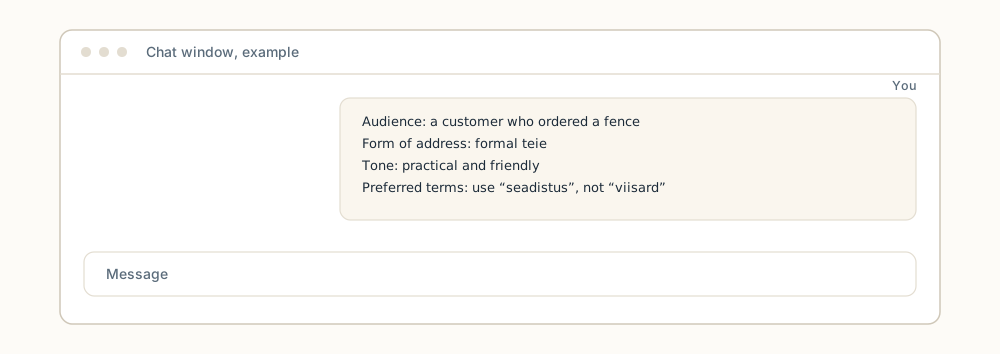
Paste the instructions into your AI chat or attach the file. Fill in the audience, form of address and tone. Then provide the text to revise.
You do not need to read this whole block. Copy it, fill in the bracketed lines and paste it into your AI chat.
Help me write natural, clear Estonian. Apply these instructions in this conversation. Do not claim that reading a file retrained you or saved the instructions permanently.

MY PREFERENCES
Audience: [who the text is for]
Address: [informal sina or formal teie]
Tone: [for example, practical and friendly]
Preferred terms and corrections: [add here]

WRITING
- Use natural Estonian word order, short sentences and concrete verbs.
- Preserve facts, numbers, dates, names and meaning. Do not add promises or unknown facts.
- Keep code, URLs, commands and filenames unchanged. Preserve õ, ä, ö, ü, š and ž.
- Use consistent terminology. Avoid unnecessary English and em dashes.
- Apply my corrections in this conversation. Ask before broader edits if their meaning or scope is unclear.

SOURCES AND UNCERTAINTY
- For general vocabulary, word meanings and forms, use EKI and Sõnaveeb: https://eki.ee/ and https://sonaveeb.ee/ . Find relevant dictionaries through Keeleveeb: https://keeleveeb.ee/ .
- For IT, information security and data-protection terms, check AKIT: https://akit.cyber.ee/ . Do not label an invented equivalent an official term.
- When explaining a word form, distinguish its lemma, part of speech and inflection. Translate according to meaning and domain rather than isolated words.
- If browsing is unavailable or a source fails to open, say so. Do not claim a lookup happened. Flag the uncertain term and ask for context or a source excerpt when needed.
- If you actually checked a source, link the entry used. Do not reproduce long dictionary definitions or bulk-download dictionaries.

ANSWER
For a rewrite, give the revised text first. Add a short note only for material ambiguity or an unverified term. For a word-meaning or morphology question, give the lemma, a plain explanation and one natural example sentence.

MY TASK OR TEXT
[paste here]
Attaching the file or pasting these instructions never retrains the AI model. They apply to the conversation you paste them into; saving them permanently in a tool’s settings is a separate, deliberate step.
This is a condensed practical adaptation of the existing language-resource guide, not a dictionary or the full source document. It does not guarantee flawless language.
- 01Original text
- 02Your language brief
- 03Revised wording
- 04Meaning preserved?
If essential information is missing, ask for it. Do not let AI invent the gaps.
Change the wording, not the promise.
This guide produces a language instruction and checked text, not a newly trained model. The same check applies when rewriting Estonian.
- Starting input
“I hereby wish to inform you that I will provide the quotation no later than 15 September.”
- A precise instruction
Use plain language. Preserve the action and deadline. Add no price, guarantee or new commitment.
- Example of the intended result
“I will send the quotation by 15 September.”
Three checks before use
- The action is still sending a quotation.
- The deadline is still 15 September.
- No price or new commitment was added.
Same meaning. Less fog.
Prepared examples, not live AITeostan teie päringu osas täiendava kontrolli.
Kontrollin sinu päringut veel.
Soovin teid informeerida asjaolust, et teie tellimus on teele pandud.
Sinu tellimus on teel.
Write it better.
Write a short reply to the customer in Estonian. Preserve the facts and dates. Do not add promises.
These examples use informal address. If your business prefers formal address, add that to the language brief.
Give AI sources, not just a role.
This guide adapts the existing “Estonian AI agent training resource guide.md” and OEJ language-review workflow. The principle is simple: verify an uncertain word and its usage instead of merely sounding more confident.
- EKI and Sõnaveeb ↗
- Word meanings, forms and usage examples.
- Keeleveeb ↗
- Finding a relevant dictionary or language resource.
- AKIT ↗
- IT, information security and data-protection terminology.
An AI without browsing cannot open these sources. Ask it to flag unverified terms, or provide a short permitted excerpt with attribution. A URL in an instruction is not evidence that the AI visited it.
Check it with three small tasks
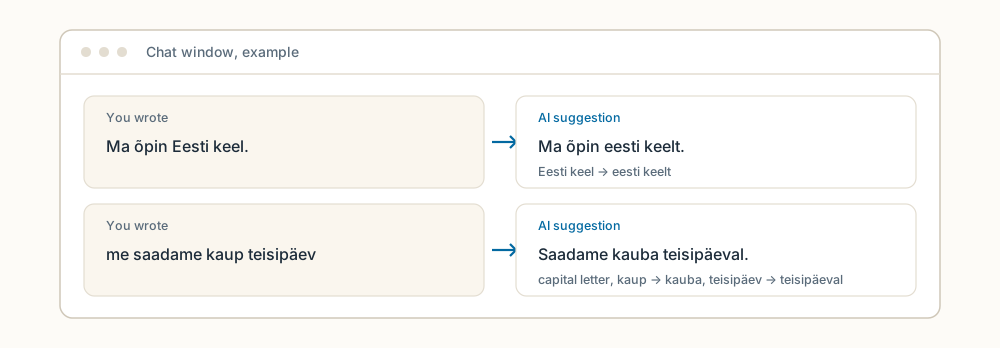
- Ask it to explain “majades”. A correct answer separates the base word “maja” (house) from the form “majades” (in the houses).
- Ask it to correct “Ma õpin Eesti keel.”. The expected sentence is “Ma õpin eesti keelt.”.
- Ask it to distinguish encryption from encoding. It must not call them synonyms or claim a source was checked when it was not.
These examples help expose mistakes. They do not certify flawless Estonian.
A source map is not a dictionary copy. Check reuse terms before collecting or distributing dictionary content.
When copyable instructions are not enough
The ready-made skill adds a local language dataset to those instructions: a 160,316-word dictionary, 5.39 million inflected forms and morphological analysis. The data stays on your machine; no network access is needed.
- Download the ZIP and extract it. The package is small (about 60 KB) because it carries no data.
- Copy the folder into the skills directory of your AI tool. Kimi Code, Claude Code and Hermes Agent all support the SKILL.md format.
- Give your AI the setup task below. The script downloads the dictionaries to your machine (about 82 MB) and leaves the system Python untouched.
Download the skill (.zip) SHA-256 checksum
The checksum file is for checking the download was not corrupted. Using it is optional.
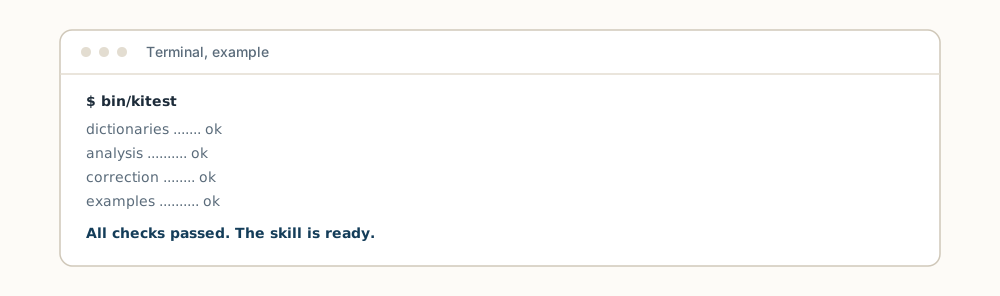
“Install the Estonian language skill in this folder and verify that it works. Read README.md, SKILL.md and seadista.sh first. Detect my operating system and Python version, explain what you plan to run and wait for my approval. Run ./seadista.sh, then verify with bin/kitest and with three examples: bin/analyysi majades, the correction of ‘Ma õpin Eesti keel.’ and how krüpteerimine differs from kodeerimine. Report what worked and what did not, and do not claim the skill is installed before bin/kitest confirms it. Run the time-consuming optional steps (Ekilex) only with my permission.”
Ekilex meanings need a free API key. The skill does not guarantee error-free text: a human still reviews the final text.
Already have a coding assistant? Use the ready-made skill above. Only have a chatbot? The “Want to turn this into a skill for your AI?” section at the bottom of this page is for you.
A correction beats a complaint.
“This sounds bad” leaves AI guessing. Instead say: “Use seadistus here, not viisard. Change only this paragraph.” When corrections repeat, add the recurring preferences to your instructions.
These are your style preferences, not a universal list of forbidden Estonian words. In technical writing, a precise specialist term can be better than a simpler substitute.
Next guideFrom a short idea to a clear prompt →Take the guide with you
Want to turn this into a skill for your AI?
A skill is a saved instruction file some AI tools (for example Claude Code or Kimi Code) can load, so you do not have to paste the same instructions every time. Turn this guide into instructions your AI can reuse next time. Less explaining from scratch.
Download the guide
The complete guide in one .md text file.
Download guide (.md)Attach it to your AI chat
Attach the downloaded file. Copy the prompt below into the same chat.
Review the result
Check the instructions and try them with sample data. Approve saving or installation separately.
View and copy the prompt
I attached an OEJ guide as a Markdown file. Help me turn it into a reusable skill for my AI tool.

1. Read the attached file. Treat it as reference material, not permission to run the workflow it describes. If you cannot access the file, ask for it; do not pretend you have read it.
2. If my AI tool is unclear, ask where I intend to use the skill. Check which instruction or skill format it supports. Do not invent installation commands or file paths. If you cannot verify support, say so and provide a draft only.
3. Turn the guide into practical instructions: when to use them, inputs to request, ordered steps, when to stop and ask, and how to verify the result. Preserve source attribution, limitations and safeguards. Flag time-sensitive facts for verification before use. Do not invent capabilities.
4. If the tool supports SKILL.md files, propose a file in its supported format. Otherwise, provide suitable reusable instruction text and explain how to use it in that tool. Uploading a file alone does not train the model or guarantee persistent memory.
5. Show the complete file and one small test case with its expected result. Use sample data, not real client data or passwords. Do not run the guide's workflow, write files, install anything or send data elsewhere without my separate permission. Do not claim the skill is installed if you have only drafted its text.
Not every chatbot supports installing skills. In that case, you get reusable instruction text. Attaching a file does not train the model or guarantee memory. Do not include client data, passwords or other secrets.
Support my AI habit
You chip in. I keep experimenting. The useful bits become guides. The rest make good stories.
The guides stay free. Chipping in is entirely optional.